 By
ByChoosing the right demolition method for your Pacific Northwest project isn’t just about tearing things down efficiently. It’s about understanding how Seattle’s tight urban lots differ from suburban Tacoma properties, how Portland’s historic building stock requires different handling than newer Everett construction, and how our region’s wet climate and environmental standards shape every decision. The method that works for a waterfront warehouse in Bellingham might be completely wrong for a Capitol Hill craftsman renovation, and knowing the difference saves time, money and headaches.
Demolition in the PNW comes with challenges you won’t find in drier, flatter regions. We’re dealing with douglas fir framing that’s dense and stubborn, concrete foundations that have weathered decades of rain, clay soils that complicate excavation, and neighborhoods where houses sit just feet apart. Add in strict environmental regulations, permitting processes that vary by city, and a building stock that ranges from century-old structures to modern glass towers, and you start to see why one-size-fits-all approaches don’t work here. Understanding the main demolition methods and when each makes sense helps property owners, developers and contractors make informed decisions that keep projects on track.
What Makes Demolition in the Pacific Northwest Unique
The Pacific Northwest isn’t just another region on the demolition map. Our climate alone changes how projects get planned and executed. Months of steady rain from October through May mean job sites stay wet, equipment works harder, and timing matters more than it does in places with predictable dry seasons. Demolition contractors working in Seattle or Tacoma learn quickly that you can’t always wait for perfect weather, but you do need strategies for managing mud, controlling runoff and protecting neighboring properties from water and debris.
Our building styles tell their own story. Older neighborhoods across Seattle, Portland and smaller cities throughout the region are filled with craftsman homes, brick commercial buildings and wood-framed structures built when old growth timber was the standard material. These buildings were constructed to last, which is wonderful for longevity but creates real challenges during demolition. Thick timbers don’t break apart easily, and foundations poured generations ago often contain aggregate and reinforcement that modern equipment handles differently than contemporary concrete.
Tight urban spacing defines much of the PNW’s residential and commercial landscape. Properties in Ballard, Portland’s Pearl District or downtown Tacoma sit shoulder to shoulder with minimal setbacks. Demolition work in these areas requires precision, careful equipment selection and constant attention to protecting adjacent buildings. You can’t swing a wrecking ball when your neighbor’s wall is three feet away, and you can’t stage debris containers wherever you want when street access is limited and parking is already scarce.
Environmental responsibility isn’t optional here. The Pacific Northwest takes recycling, waste diversion and environmental protection seriously, and demolition projects operate under regulations that reflect those values. Materials get sorted, concrete gets recycled, hazardous substances get handled properly, and contractors who cut corners face consequences. This regulatory environment shapes how demolition happens and why experienced local contractors know that doing things right the first time is the only viable approach.
Mechanical Demolition Explained
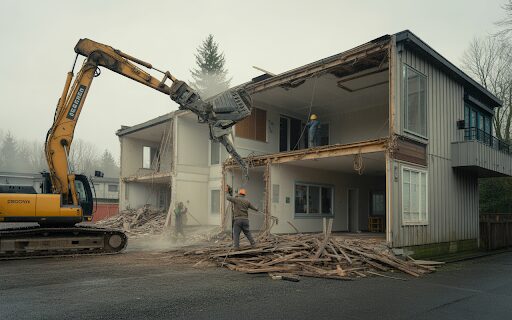
Mechanical demolition uses heavy equipment like excavators, bulldozers and loaders to physically tear down structures. It’s the method most people picture when they think about demolition, with machines pulling apart walls, collapsing roofs and loading debris into trucks for hauling. Excavators equipped with hydraulic shears, grapples or buckets do most of the work, systematically dismantling buildings from top to bottom while operators control the collapse and manage debris.
This approach works best for complete teardowns where the entire structure is coming down and there’s no need to preserve adjacent buildings or specific elements. Older single family homes being cleared for new construction, aging commercial buildings at the end of their useful lives, and industrial structures that have outlived their purpose are all good candidates for mechanical demolition. The method is efficient, relatively fast, and well suited to projects where speed and complete removal matter more than surgical precision.
In the Pacific Northwest, mechanical demolition happens constantly across residential neighborhoods undergoing redevelopment. Seattle’s steady tear down and rebuild activity, Portland’s urban infill projects, and suburban growth throughout Tacoma and Everett all rely on mechanical methods to clear outdated housing stock and make room for modern builds. Companies like Prime Demolition in Seattle handle these projects routinely, bringing the right equipment to navigate narrow residential streets, working carefully to avoid damaging neighboring properties, and managing debris in compliance with local recycling and disposal regulations.
Weather affects mechanical demolition more than people realize. Wet ground conditions common throughout fall and winter make equipment operation challenging and can tear up yards if contractors aren’t careful. Experienced PNW demolition teams know how to work around rain, when to pause during heavy downpours, and how to protect sites from turning into mud pits that delay projects and create cleanup headaches.
Selective Demolition Explained
Selective demolition takes a surgical approach, removing specific portions of a structure while preserving the rest. Instead of tearing everything down, contractors carefully extract walls, floors, roofing or other elements according to plans that specify exactly what stays and what goes. This method requires more planning, closer coordination with engineers and architects, and operators who can work precisely without causing unintended damage.
Selective demolition shines in situations where buildings are being renovated rather than replaced, where additions are being removed from otherwise sound structures, or where historic preservation requires maintaining certain elements while updating others. It’s common throughout the Pacific Northwest’s older neighborhoods where homeowners and developers see value in preserving building character while modernizing interiors and systems.
Portland’s emphasis on historic preservation makes selective demolition especially relevant. Buildings with protected facades or architectural features require contractors who can remove interiors, update structural systems and prepare spaces for new uses without touching the elements that give buildings their historic designation. Seattle’s frequent condo and apartment renovations follow similar patterns, with developers gutting interiors while maintaining building envelopes and sometimes even preserving specific architectural details that define a property’s character.
The method demands careful planning and coordination. Load bearing walls can’t be removed without temporary shoring and engineered support beams. Utilities need rerouting to maintain service to portions of buildings remaining intact. Dust and debris must be controlled more carefully than in full teardowns since adjacent spaces or neighboring buildings stay occupied. Prime Demolition and other experienced contractors handle these complications daily, working alongside architects and structural engineers to execute selective demolition that meets project goals without creating new problems.
Interior Gutting Explained
Interior gutting strips buildings down to their structural shells, removing partition walls, ceilings, flooring, fixtures and finishes while leaving the building envelope intact. It’s a specific type of selective demolition focused entirely on interior spaces, and it’s incredibly common throughout the Pacific Northwest’s urban cores where older buildings get repurposed for new uses.
Office buildings being converted to residential lofts, retail spaces getting reconfigured for new tenants, and restaurants changing concepts all require interior gutting. The goal is clearing out everything associated with previous uses while maintaining the weatherproof exterior and structural frame. What’s left is essentially an empty shell ready for new layouts, updated mechanical systems and finishes that match current needs.
Seattle’s South Lake Union neighborhood provides endless examples. Former industrial buildings and older office structures have been gutted and transformed into tech offices, apartments and mixed use developments. The exteriors sometimes maintain their original character while interiors become completely modern spaces that bear no resemblance to what came before. This transformation requires skilled interior demolition that removes everything efficiently without damaging structural elements that support the building.
Interior gutting in the PNW often involves dealing with decades of accumulated modifications. Buildings constructed in the early 1900s have usually been renovated multiple times, with layers of updates stacked on top of original construction. Gutting these spaces means carefully identifying what’s structural and what’s not, a task that requires experience and sometimes input from engineers who can assess conditions and confirm what can safely be removed.
Dust control becomes critical during interior gutting, especially in occupied buildings. Filtering systems, barriers and scheduling work during off hours help minimize disruption to tenants or neighboring businesses. Contractors working in cities like Seattle and Portland know these considerations are non-negotiable and plan accordingly.
Concrete Removal Explained
Concrete removal focuses specifically on breaking apart and hauling away concrete structures like foundations, slabs, driveways, patios and parking areas. It’s a specialized aspect of demolition that requires hydraulic breakers, concrete saws and equipment capable of handling the weight and density of reinforced concrete. While concrete removal often happens as part of larger demolition projects, it’s also a standalone service for property owners who need driveways replaced, old foundations extracted or site preparation completed.
The Pacific Northwest has plenty of aging concrete that eventually needs removal. Older homes throughout Seattle, Tacoma and Portland sit on foundations poured decades ago, and when those structures are torn down, the concrete must come out too. Commercial properties have parking lots and loading areas that crack and settle over time, requiring removal and replacement. Residential driveways throughout the region reach the end of their useful lives after years of weather exposure and vehicle traffic.
Concrete removal in PNW conditions involves dealing with material that’s been saturated by rain for years or decades. Moisture doesn’t weaken concrete structurally, but it does affect how the material breaks and how heavy it becomes during loading and hauling. Reinforcement with rebar is standard in most concrete work, and separating steel from broken concrete adds steps to the process but also allows both materials to be recycled rather than landfilled.
Removing foundations requires excavation that accounts for PNW soil conditions. Clay soils common throughout Seattle and surrounding areas don’t drain well, and excavations often fill with water during rainy months. Contractors handle this routinely, pumping water as needed and managing site conditions to keep work progressing safely. The excavated areas get backfilled with compacted material that prevents settling and prepares sites for whatever comes next.
Concrete recycling is standard practice throughout the region. Broken concrete gets hauled to processing facilities where it’s crushed into aggregate used for road base, fill material or new concrete production. This approach reduces landfill waste and aligns with the environmental values that shape how construction and demolition happen across Washington and Oregon.
How to Decide Which Method Fits Your Project
Choosing the right demolition method starts with understanding your project goals. Are you clearing land for new construction, renovating an existing building, or removing specific elements while preserving the rest? The answer points toward mechanical demolition, selective removal or interior gutting respectively. Budget matters too, since selective work and interior gutting require more labor and time than full mechanical teardowns.
Site conditions influence decisions significantly. Tight urban lots favor methods that offer precision and control. Properties with room to maneuver can accommodate larger equipment and faster mechanical approaches. Access constraints affect equipment choices and timelines. Buildings surrounded by mature landscaping, fencing or neighboring structures require careful planning regardless of method.
Permit requirements and environmental regulations shape which approaches are feasible. Projects in historic districts may require selective methods that preserve certain elements. Contaminated sites need environmental assessments before any demolition begins. Hazardous materials like asbestos must be abated before structures can be torn down, regardless of method.
Local expertise makes these decisions easier. Demolition contractors who work regularly in the Pacific Northwest understand how different methods perform under regional conditions. They’ve navigated permitting in Seattle, Tacoma and Portland. They know which equipment works best on clay soils and hillside properties. They understand how to sequence work to keep projects moving through rainy months. Companies like Prime Demolition bring this knowledge to every project, helping clients choose approaches that match their goals, budgets and site realities.
The consultation process typically involves site visits where contractors assess buildings, evaluate access, identify complications and discuss options. Good contractors explain trade-offs between methods, provide realistic timelines and deliver transparent pricing. They ask questions about your plans for the property after demolition, timelines you’re working within and any concerns you have about neighboring properties or site conditions.
Closing Thoughts
Demolition might seem straightforward from the outside, but anyone who’s managed a project in the Pacific Northwest knows it involves dozens of decisions that affect outcomes, costs and timelines. Understanding the main methods and when each makes sense helps you approach projects with realistic expectations and the knowledge needed to work effectively with contractors.
Mechanical demolition delivers speed and efficiency for complete teardowns. Selective methods preserve what matters while removing the rest. Interior gutting transforms buildings from the inside out. Concrete removal clears foundations and site features that stand in the way of new construction or landscaping. Each has its place depending on what you’re trying to accomplish.
If you’re planning a demolition project anywhere in the greater Seattle area or throughout the Pacific Northwest, connecting with experienced local contractors makes everything easier. Prime Demolition has handled projects across every method discussed here, from residential teardowns in neighborhood settings to complex selective demolition in commercial buildings. Their team understands PNW conditions, permitting processes and the techniques that deliver clean, efficient results.
Reach out early in your planning process to discuss which demolition approach fits your project best. The right guidance upfront prevents costly mistakes and keeps your development, renovation or site preparation moving forward smoothly. Demolition done right sets the foundation for everything that follows, and working with contractors who know this region ensures your project starts on solid ground.